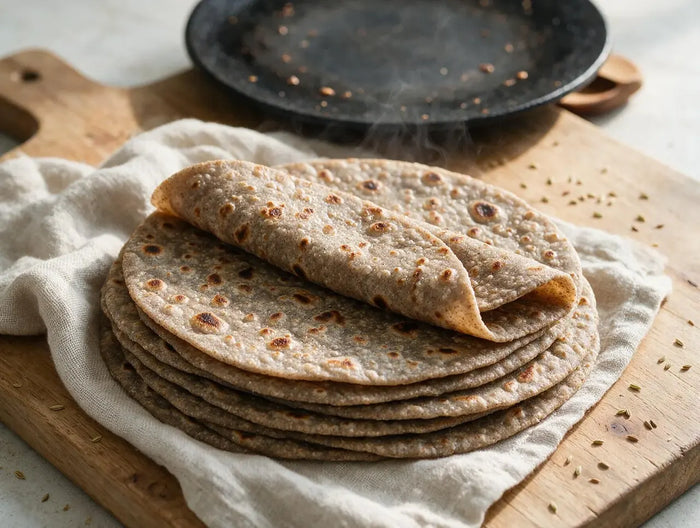
A thick, rustic bajra roti patted in the palm the way makki roti is, edges cracked and toasted, centre soft. Made for sarson saag and white butter.
Ingredients
From the TrooFoodz pantry
- Sprouted Bajra Flour 2 1/2 cups
Fresh
- Hot water 1 1/2 cups
- Salt 1 tsp
- Ghee, to finish 3 tbsp
- White butter, to serve 4 tsp
- Sarson saag, to serve 3 cups
Method
-
Scald and cover
Pour hot water over the salted Sprouted Bajra Flour, cover the bowl and leave it four minutes so the coarse particles soften before you touch the dough.
-
Knead in batches
Knead only a third of the dough at a time, keeping the rest covered and warm. Bajra dough that cools will not hold a shape.
-
Pat between palms
Roll a ball, then slap it from palm to palm, flattening a little with each pass, until it is 14 cm across and roughly 5 mm thick — thicker than a roti, thinner than a bhakri.
-
Mend the cracks
Pinch any splits at the rim closed with wet fingertips. A cracked edge will dry out and burn before the middle cooks.
-
Cook on medium
Lay on a moderately hot tawa and cook slowly, three minutes a side. High heat sets the outside long before the thick centre is done.
-
Finish on flame
Move the roti onto a wire rack over a low direct flame for 30 seconds a side until it swells and picks up dark toasted patches.
-
Butter and break
Break the roti open by hand, drop white butter into the crack and serve with hot sarson saag.
Why this works
A thick millet roti is a heat-management problem: the surface has to stay slow enough not to seal before the interior gelatinises. Palm-patting keeps the disc uneven in a useful way, giving thin spots that puff and thick spots that stay soft, and the final flame finish drives out surface moisture for that toasted flavour.
Make it your own
- Sprouted Bajra Flour → Sprouted Jowar Flour Lighter and sweeter; pat a little thinner.
- Sarson saag → Palak and methi saag Softer and less pungent, with more body.
- White butter → Ghee Warmer and nuttier, and it does not melt away as fast.